Mission:
To provide the state-of-the-art quality care to patients with musculoskeletal tumors
The treatment of patients with malignant neoplasms of the musculoskeletal system has changed dramatically over recent years. This is reflected in many aspects of the overall field of oncology. In the early 1970s, the standard treatment for high-grade bone and soft tissue sarcomas involved amputation at or above the affected joint. Advances in chemotherapy, reconstructive surgery, bioengineering, and prosthetics have recently allowed surgeons to successfully remove the tumor and reconstruct the limb. The era of limb preservation was initiated in the late 1980s, and Hong Kong followed suit.
Musculoskeletal Tumors at the Prince of Wales Hospital
Although primary bone neoplasms are rare, making up about 1% of all malignant conditions, bone and soft tissue tumors account for 10% of malignant cases reported in children. Over the years, our department at the Prince of Wales Hospital has developed significant expertise in the management of musculoskeletal neoplasms.
This institution is a recognized quaternary referral center for the management of patients with musculoskeletal bone and soft-tissue malignancies from the entire New Territories, serving a population of 3 million. It has a dedicated multidisciplinary team (MDT) consisting of radiologists, pathologists, and orthopedic oncology surgeons, all experienced in initial diagnostic workup and surgical procedures such as oncological resection, microvascular reconstruction, and megaprosthetic reconstruction. Our surgical efforts are supported by an excellent oncology department, enabling us to offer preoperative adjuvant therapies, including chemotherapy or radiotherapy, for malignant tumors. Our pioneering work in limb preservation surgery has been recognized, and our department remains at the forefront of providing this service to Hong Kong.
Limb Preservation Surgery
With advances in chemotherapy, excellent tumor necrosis can be achieved preoperatively. This enhances the effect of surgical excision. Local tumor control can therefore be effectively accomplished without the need for a mutilating amputation. Large bone and soft tissue defects can be appropriately replaced, thereby salvaging useful limb function. This outcome is especially rewarding for patients, who are mostly children or young adults. Almost all our primary bone tumors occur at Stage II, and we successfully perform Limb Salvage in 90% of cases.
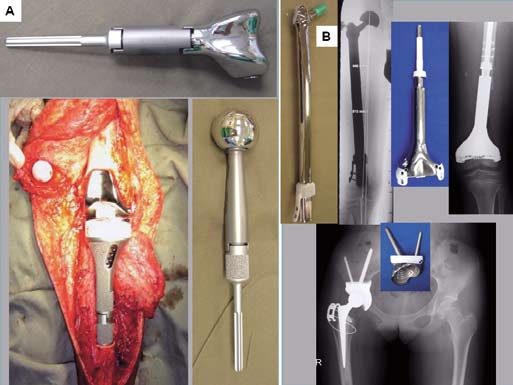 (A) Modular (B) Custom tumor prostheses
Limb Reconstructive Surgery
In our unit, over 200 allografts have been used for reconstructing massive bone defects after tumor resection in limb salvage surgery. Although 20% of patients can achieve good to excellent functional outcomes within 10 years, there are up to 30-40% of complications following allograft reconstruction. These complications include infection, fracture, nonunion, chronic rejection, and unstable joints. Additionally, the source of allografts is limited since there are few bone donors each year in Hong Kong.
With financial support from the Children's Cancer Foundation and Samaritan Fund, our unit has been using metal tumor prostheses for limb salvage reconstruction since 2003. The latest design of tumor prosthesis is more durable and provides excellent functional results. Short-term complications are minimal, and rapid functional recovery helps facilitate postoperative chemotherapy. The prosthesis can also be custom-made to fit individual needs and extended to correct leg-length discrepancies, which are common after limb-salvage surgery for pediatric bone tumors.
Computer-Assisted Tumor Surgery (CATS)
The Orthopaedic Oncology Team has been developing various computer-assisted technologies to enhance precision in surgical planning and execution. It includes computer navigation (2006), 3D-printed physical models and resection guides (2011), to Immersive Mixed Reality Technology (2021).
 Computer navigation
 3D-printed bone resection guide
 3D bone tumor hologram overlaid onto the patient for surgical planning in Mixed Reality
Achievements
| 1986 |
First allograft reconstruction
|
| 1992 |
Bone bank was established
|
| 1995 |
Basic research on Giant cell tumor of bone was started
|
| 2003 |
First tumor prosthetic reconstruction for patients with osteosarcoma in PWH
|
| 2004 |
Perform the 1st computer aided design (CAD) custom pelvic prosthesis in Hong Kong and Asia;
Perform the 1st
minimally invasive extendible custom tumor prosthesis in Hong Kong
|
| 2005 |
Set up the 1st multidisciplinary team on managing pelvic tumors in NTEC and Hong Kong
|
| 2006 |
Perform the 1st noninvasive extendible (magnet-driven) custom tumor prosthesis in Hong Kong and Asia
|
| 2008 - present |
Our work on “Bone tumor surgery with computer navigation” was chosen as one of the two leaders (the other is liver
transplants from HKU) in medical science and a pioneering member of international medical fraternity in applied
research and practice in Hong Kong in 2008. It is published by Information Services Department – Hong Kong
Special Administrative Region (HKSAR) Government.
|
| 2008 - present |
The founder and world opinion leader in Computer Assisted Tumor Surgery (CATS) and have collaborated with
commercial company (Stryker Navigation) to develop an Orthopaedic Tumor Navigation System (OrthoMap 3D). It is
the first of its kind in the World and has been launched internationally since 1 Jan, 2009
|
| 2008 - 2011 |
The only team in the world that can organize and conduct 1st to 3rd international workshop on Computer Assisted
Tumor Surgery
|
| 2009 |
|
| 2010 |
Published the book “A Practical Guide for Computer Assisted Tumor Surgery (CATS)”, the first and the only one of its
kind in the world describing this advanced technology in orthopaedic oncology
|
| 2012 |
Developed and published the world 1st tumor Patient Specific Instrument (Tumor- PSI) in bone tumor resection and
custom prosthetic reconstruction |
| 2013 |
Performed the first 3D-printed Pelvic prosthesis for a patient with low-grade pelvic chondrosarcoma in Asia |
| 2016 |
World’s 1st to combine both computer navigation and 3D-printed resection guides in joint-sparing resection and custom prosthetic reconstruction in limb sarcoma surgery |
| 2021 |
Pioneer in developing and utilizing immersive Mixed Reality technology for surgical planning at the clinical point of care in Orthopaedic Oncology |
Representative Publications on GCTB
| 1. |
Giant cell tumor of bone. Yip KM, Leung PC, Kumta SM. Clin Orthop Relat Res. 1996 Feb;(323):60-4. |
| 2. |
Gene expression of glucocorticoid receptor alpha and beta in giant cell tumour of bone: evidence of glucocorticoid-stimulated osteoclastogenesis by stromal-like tumour cells. Huang L, Xu J, Kumta SM, Zheng MH. Mol Cell Endocrinol. 2001 Jul 5;181(1-2):199-206. |
| 3. |
Tumour cells produce receptor activator of NF-kappaB ligand (RANKL) in skeletal metastases. Huang L, Cheng YY, Chow LT, Zheng MH, Kumta SM. J Clin Pathol. 2002 Nov;55(11):877-8. |
| 4. |
Expression of VEGF and MMP-9 in giant cell tumor of bone and other osteolytic lesions. Kumta SM, Huang L, Cheng YY, Chow LT, Lee KM, Zheng MH. Life Sci. 2003 Aug 1;73(11):1427-36. |
| 5. |
Expression of preosteoblast markers and Cbfa-1 and Osterix gene transcripts in stromal tumour cells of giant cell tumour of bone. Huang L, Teng XY, Cheng YY, Lee KM, Kumta SM. Bone. 2004 Mar;34(3):393-401. |
| 6. |
Bisphosphonates induce apoptosis of stromal tumor cells in giant cell tumor of bone. Cheng YY, Huang L, Lee KM, Xu JK, Zheng MH, Kumta SM. Calcif Tissue Int. 2004 Jul;75(1):71-7. |
| 7. |
CCAAT/enhancer binding protein beta is up-regulated in giant cell tumor of bone and regulates RANKL expression. Ng PK, Tsui SK, Lau CP, Wong CH, Wong WH, Huang L, Kumta SM. J Cell Biochem. 2010 May 15;110(2):438-46. |
| 8. |
Pamidronate, farnesyl transferase, and geranylgeranyl transferase-I inhibitors affects cell proliferation, apoptosis, and OPG/RANKL mRNA expression in stromal cells of giant cell tumor of bone. Lau CP, Huang L, Tsui SK, Ng PK, Leung PY, Kumta SM. J Orthop Res. 2011 Mar;29(3):403-13. |
| 9. |
p63 regulates cell proliferation and cell cycle progression‑associated genes in stromal cells of giant cell tumor of the bone. Lau CP, Ng PK, Li MS, Tsui SK, Huang L, Kumta SM. Int J Oncol. 2013 Feb;42(2):437-43. |
| 10. |
Comparison of the anti-tumor effects of denosumab and zoledronic acid on the neoplastic stromal cells of giant cell tumor of bone. Lau CP, Huang L, Wong KC, Kumta SM. Connect Tissue Res. 2013;54(6):439-49. |
| 11. |
Simvastatin Possesses Antitumor and Differentiation-Promoting Properties That Affect Stromal Cells in Giant Cell Tumor of Bone. Carol P. Y. Lau, Cathy S. H. Fung, Kwok Chuen Wong, Yu-Hsuan Wang, Lin Huang, Stephen K. W. Tsui, Oscar K. Lee, Shekhar M. Kumta. J Orthopaedic Research 2022. Volume 38, Issue 2, Pages 229-458 |
| 12. |
Local Recurrence After Minimally Invasive Curettage For Primary Giant Cell Tumor of Bone With Perioperative Bisphosphonate Is Comparable to Open Curettage: Retrospective Comparison With 9-Year Follow-Up. Lau HW, Wong KC, Chiu WK, Kumta SM. Arthroscopy, Sports Medicine, and Rehabilitation 2021, Volume 3, Issue 6, Pages e1729-e1736. |
| 13. |
Development of deep learning algorithms to discriminate giant cell tumors of bone from adjacent normal tissues by confocal Raman spectroscopy. Carol P. Y. Lau, Wenao Ma, Kwan Yau Law, Maribel D. Lacambra, Kwok Chuen Wong, Chien Wei Lee, Oscar K. Lee, Qi Dou, Shekhar M. Kumta. March 2022. The Analyst 147(7) |
|



